Urodynamics Clinic Ireland: AI Scheduling & Billing for Urologists
Optimise your urodynamics clinic in Ireland with AI scheduling and insurer billing workflows designed to eliminate diagnostic bottlenecks and claim rejections.
Researched and written by Ask Brigid's AI pipeline and published automatically — not individually reviewed by a person. Useful as a starting point; check clinical, legal and regulatory details against a primary source before relying on them.

Built in Dublin · GDPR · Early access
Ask Brigid takes the admin so the clinic day stays clinical.
The Operational Bottlenecks in Modern Irish Urodynamics Clinics
Operational bottlenecks in an Irish urodynamics clinic stem from misaligned procedural scheduling, heavy administrative friction across private urologist Laya claims and multi-insurer verification, fragmented pre-procedure intake such as unreturned paper bladder diaries, and costly diagnostic suite vacancy when multi-stage investigations overrun or face last-minute cancellations due to urinary tract infections.
Much like navigating urology pre-authorisation in Ireland, a private urologist operates under distinct structural constraints. Unlike standard fifteen-minute outpatient consultations, a urodynamic study (UDS) is an invasive, multi-stage physiological investigation. Whether practicing out of dedicated suites in the Beacon Hospital, Mater Private, Blackrock Clinic, Hermitage Clinic, Bons Secours, or UPMC Whitfield, a urodynamics list requires precise coordination between the consultant, a specialised urology nurse or Clinical Nurse Specialist (CNS), and specialised diagnostic hardware.
When an investigation falls behind schedule, the repercussions ripple across wider urology theatre list management in Ireland and outpatient scheduling. A single urodynamics list often accommodates a diverse mix of complex clinical presentations: refractory overactive bladder (OAB) being assessed for intravesical botulinum toxin (Botox) or sacral neuromodulation, men with persistent lower urinary tract symptoms (LUTS) post-transurethral resection of the prostate (TURP), and neuro-urology patients with multiple sclerosis or spinal cord injuries requiring meticulous baseline pressures to assess upper tract risk.
Much like streamlining urologist documentation and patient letters, the administrative burden surrounding these specialised lists is significant:
- Fragmented pre-test data collection: Patients arriving without completed 3-day frequency-volume charts (bladder diaries) force clinicians to choose between proceeding with incomplete diagnostic baselines or re-booking the slot.
- Unscreened urinary tract infections: Asymptomatic bacteriuria turning into symptomatic pyuria on the morning dipstick aborts the procedure immediately to avoid urosepsis, leaving an expensive 60-minute diagnostic block unused.
- Complex multi-insurer authorisation rules: Discrepancies between VHI, Laya Healthcare, and Irish Life Health regarding billing codes for complex multichannel cystometry versus simultaneous electromyography (EMG) lead to payment rejections and hours of administrative reconciliation.
- Dictation and reporting backlog: Interpreting detrusor leak point pressures, bladder compliance, and pressure-flow curves requires meticulous documentation that frequently spills over into evening administrative hours.
Resolving these friction points requires moving away from static room booking systems and uncoordinated intake methods toward automated clinical pathways tailored specifically to private urology workflows.
 ▶ Watch on YouTube
How Dynamic Scheduling Manages Multi-Stage Urodynamic Investigations
Dynamic scheduling manages multi-stage urodynamic investigations by automatically allocating variable procedure buffers, grouping patients based on mobility or catheterisation complexity, and factoring in equipment recalibration intervals. This structured allocation eliminates room overruns between uroflowmetry, filling cystometry, and pressure-flow studies while preventing downstream clinic delays across busy diagnostic suites.
A standard urodynamic investigation cannot be compressed into a uniform appointment block. Setting identical 45-minute slots for every patient on a list almost guarantees scheduling failure. A dynamic urology scheduling software model categorises bookings by clinical complexity, mobility status, and patient anatomy before allocating specific slot lengths.
Consider the sequential stages of a standard multichannel urodynamic pathway and their variable operational time demands:
- Non-Invasive Uroflowmetry & Post-Void Residual (PVR): The patient must arrive with a comfortably full bladder to produce a representative void (>150 mL). If the patient voids prematurely in the waiting area, a mandatory 30-to-45-minute hydration buffer is introduced before the trace can even begin. Post-void bladder scanning adds an initial baseline measurement.
- Catheterisation & Transducer Zeroing: Placing dual-lumen transurethral measuring catheters and rectal balloon catheters to measure abdominal pressure ($P_{abd}$) requires varying amounts of time. A female patient with straightforward anatomy differs significantly from a male patient with a tight urethral stricture, high bladder neck, or severe benign prostatic hyperplasia (BPH) requiring gentle passage with a specialised Coudé-tip catheter.
- Filling Cystometry: Infusing sterile saline or contrast medium at physiological rates (typically 20–50 mL/min for neurogenic bladders, up to 100 mL/min for non-neurogenic cases) to identify detrusor overactivity, calculate compliance ($\Delta V / \Delta P_{det}$), and evaluate first sensation, normal desire, and strong desire to void. Provocative manoeuvres (coughing, heel bouncing, listening to running water) must be documented accurately without rushing.
- Pressure-Flow (Voiding) Studies: Assessing detrusor pressure at maximum flow ($P_{det}Q_{max}$) alongside maximum flow rate ($Q_{max}$) allows calculation of the Bladder Outlet Obstruction Index ($BOOI = P_{det}Q_{max} - 2Q_{max}$) and the Bladder Contractility Index ($BCI = P_{det}Q_{max} + 5Q_{max}$). For women, pressure-flow criteria evaluate functional or anatomical outflow resistance.
- Post-Test Debrief & Hygiene: Catheter removal, patient dressing, addressing immediate procedural discomfort, and cleaning/calibrating fluid lines and transducer domes ready for the subsequent session.
| Patient Clinical Profile | Procedural Elements | Recommended Buffer | Total Suite Allocation |
|---|---|---|---|
| Standard Stress/Urge Incontinence (Ambulatory, straightforward anatomy) | Free uroflow, PVR scan, dual-channel cystometry, cough leak point tests, voiding study | 10 minutes (Room clean/recalibrate) | 45 minutes |
| Obstructive Male LUTS / Post-Prostatectomy (Moderate stricture risk, BPH) | Uroflow, catheterisation with Coudé-tip, filling cystometry, BOOI calculation | 15 minutes (Catheter placement variance) | 60 minutes |
| Neuro-Urology / Immobility (Spinal injury, MS, hoist transfers required) | Transfer, slow physiological fill, continuous compliance check, pelvic floor EMG | 20 minutes (Transfer & slow-fill buffer) | 75 minutes |
Dynamic scheduling software automates these allocations based on initial triage information provided by the referring general practitioner or consultant assessment, ensuring the clinic schedule reflects procedural reality rather than an arbitrary calendar template.

Pre-Procedure Patient Pathways: Digital Bladder Diaries & Intake
Digital patient pathways streamline urodynamic preparation by automating the collection of 3-day frequency-volume charts, medication logs, symptom scores such as IPSS or ICIQ, and infection screenings prior to the appointment date. Gathering structured data digitally prevents avoidable clinic-day cancellations caused by active urinary tract infections or incomplete diagnostic baselines.
For decades, private urology rooms have posted three-day paper bladder diaries to patients with instructions to bring them completed on the morning of their test. The reality in an Irish setting is predictable: paper charts are frequently forgotten at home, filled in retrospectively in the waiting room with inaccurate estimates, or lost in transit.
A modern digital intake architecture engages the patient via structured mobile prompts starting seven days before the scheduled investigation:
- Automated Medication Adjustments: Depending on the clinical indication, specific medications must be held to avoid masking genuine bladder physiology. The pathway issues clear, timed notifications regarding when to stop antimuscarinics (e.g., solifenacin, tolterodine) or beta-3 adrenoceptor agonists (e.g., mirabegron) prior to testing, or whether to continue alpha-blockers (e.g., tamsulosin) when assessing treatment failure.
- Digital Frequency-Volume Charting: Through Brigid Patient, patients log fluid intake volumes, micturition episodes, leakage events, and pad usage directly on their mobile device in real time. Patients maintain full ownership of their administrative records and test schedules, choosing to share structured intake data with their treating consultant before attending the suite.
- Infection Risk Stratification: Forty-eight hours prior to the procedure, the automated pathway prompts the patient regarding dysuria, fever, offensive urine, or new loin pain. If symptoms are flagged, the patient is redirected for local midstream urine (MSU) testing or dipstick evaluation rather than travelling to the diagnostic suite only to be turned away.
- Digital Informed Consent: Invasive physiological testing requires comprehensive consent. Explaining the risks of transient haematuria, post-procedure dysuria, and a 2–4% risk of urinary tract infection via structured digital documentation aligns with Medical Council of Ireland standards and allows patients to review procedural details at home without time pressure. For a deeper analysis on legal defensibility, review our guide on digital consent forms in Ireland.
When structured digital data arrives before the patient steps into the clinic, the private urologist spends less time collecting basic metrics and more time focused on dynamic pressure measurements and management plans.
Navigating Insurer Rules: Automated Billing for Cystometry and EMG
Automated billing navigates Irish private health insurer rules by matching exact clinical codes for complex cystometry, pressure-flow studies, and electromyography against distinct policy schedules from VHI, Laya Healthcare, and Irish Life Health. Automated pre-authorisation validation prevents delayed claims and code bundling rejections before invoices reach insurer clearinghouses.
Urodynamics billing across Irish private medical insurance providers is notoriously complex. While an outpatient consultation uses a straightforward code, multichannel urodynamic investigations involve multiple component codes that vary significantly between insurers. Submitting an incorrect code combination, failing to attach a pre-authorisation number, or unbundling disallowed elements leads to rejected claims and prolonged payment cycles.
According to clinical operational data tracked across private surgical rooms, rejected claims add an average of 14 to 28 days to accounts receivable cycles. Private urologists must adhere strictly to the schedule of benefits published by each primary insurer.
| Clinical Component | Billing Classification | Insurer Nuances (VHI / Laya / Irish Life) |
|---|---|---|
| Complex Multichannel Cystometry (Filling + Voiding Pressure-Flow) | Primary procedural code for UDS | Requires specific pre-approval indicating failed conservative medical therapy for urge/stress UI or refractory BPH. |
| Pelvic Floor Electromyography (EMG) (Concentric needle or surface patch electrodes) | Diagnostic neuro-urology add-on | Bundled automatically by certain insurers if billed alongside simple cystometry; requires explicit diagnosis of detrusor-sphincter dyssynergia (DSD) or neurogenic bladder. |
| Urethral Pressure Profiling (UPP) | Supplementary outflow evaluation | Often rejected if billed concurrently with standard pressure-flow studies unless specific functional sphincter incompetence is documented. |
| Facility Fee vs. Professional Fee | Split hospital/rooms allocation | If performed in private rooms, consumables (catheters, transducers, lines) must be billed under room-use codes; hospital-based sessions bill professional fee only. |
Implementing multi-insurer billing automation ensures that as soon as the urologist marks the procedure complete, the system applies the exact rules engine for the patient's verified policy. If a patient is insured via Laya Healthcare, the software selects Laya-specific procedure codes, attaches the verified membership and pre-authorisation numbers, and verifies that co-payments or excess amounts are flagged instantly for direct settlement.
Integrating Urodynamic Equipment Data with Consultant Billing Records
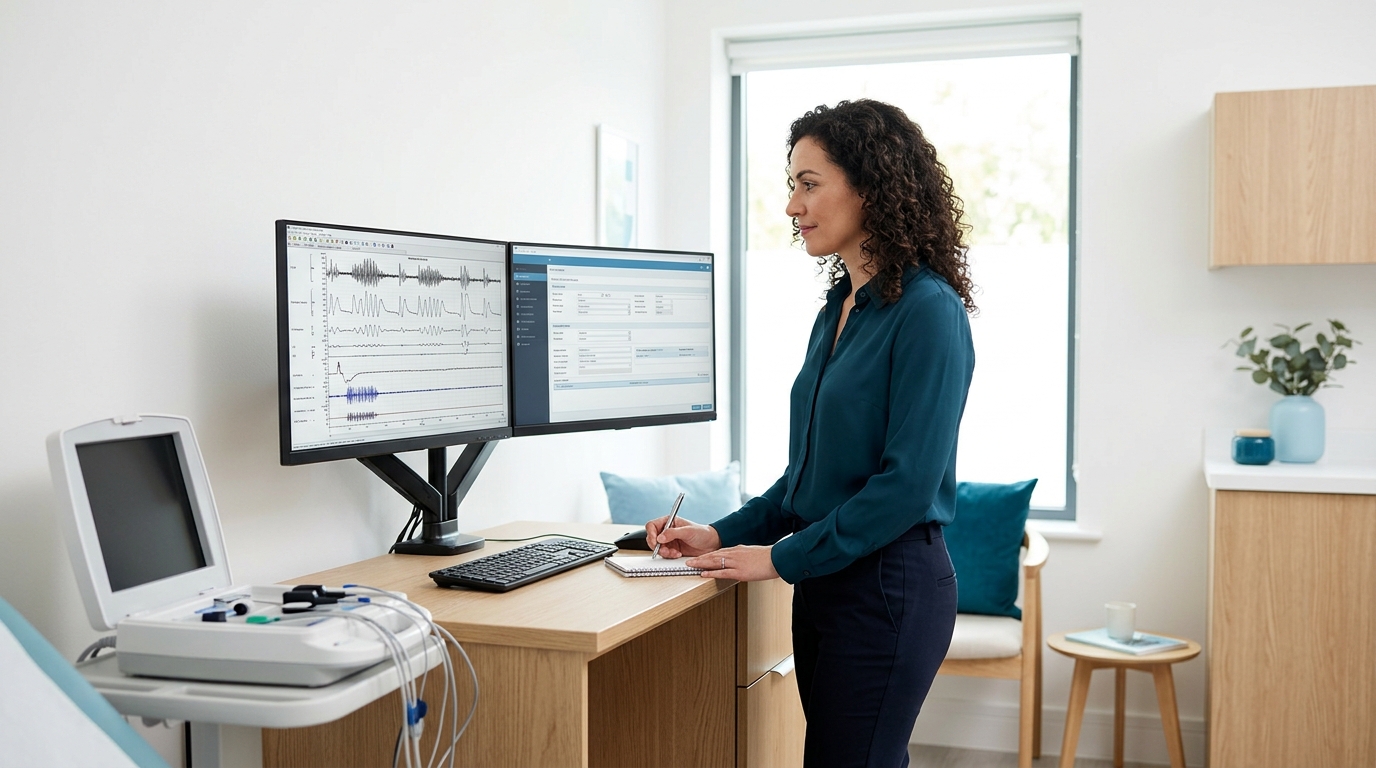
Integrating urodynamic diagnostic equipment with administrative software ensures trace interpretations, compliance metrics, and physiological measurements are automatically linked to billing entries and clinic letters. This human-in-the-loop workflow removes double data entry, validates that all billed diagnostic sub-components are clinically documented, and generates formatted consultation reports for referring general practitioners.
Modern urodynamics systems (such as those manufactured by Laborie, Andromeda, or Albyn Medical) generate rich physiological traces: fill volumes, detrusor pressure curves ($P_{det} = P_{ves} - P_{abd}$), infused volume markers, maximum flow rates, and EMG firing patterns. In many Irish rooms, however, these systems remain isolated diagnostic islands.
The standard manual routine is inefficient: the nurse or technician prints out physical paper traces, the consultant hand-annotates the graphs, dictates a letter into a dictaphone, and a medical secretary later transcribes the recording, types up the values, and matches paper records to insurer claim forms.
By modernising this bridge, administrative automation connects physiological parameters directly to clinical letters and accounts:
- Structured Parameter Extraction: Key diagnostic values—$Q_{max}$, voided volume, post-void residual, opening detrusor pressure, pressure at maximum flow, presence of involuntary detrusor contractions (detrusor overactivity), and calculated BOOI—are recorded into structured fields rather than unstructured narrative text.
- Clinician-Supervised AI Letter Generation: Using specialized clinical AI assistants like Brigid, the software takes these structured urodynamic parameters alongside the consultant's brief clinical impression and drafts a polished, comprehensive GP letter in seconds. The consultant reviews the draft, adjusts the clinical management recommendations (e.g., initiating solifenacin 5 mg daily, booking for flexible cystoscopy, or listing for artificial urinary sphincter placement), and signs off. The AI never autonomously issues medical letters or makes clinical decisions; it drafts the documentation, leaving final clinical sign-off strictly with the specialist.
- Automated Audit and Registry Compliance: Structured reporting allows private urologists to track their clinical outcomes over time, audit the diagnostic accuracy of their BPH surgical indications against Royal College of Surgeons in Ireland (RCSI) standards, and extract data effortlessly for clinical revalidation with the Medical Council.
This automated bridge between diagnostic measurement, communication, and invoicing protects up to forty-five minutes of administrative time per clinical list, freeing the specialist to focus on surgical planning and patient consultations.
Preventing Room Underutilisation and Late Cancellations
Preventing room underutilisation requires automated multi-touch reminder sequences, pre-procedure dipstick reminders, and dynamic waitlist backfilling to reallocate vacant 60-minute diagnostic slots immediately. Proactive communication reduces non-attendance rates and ensures high-capital diagnostic rooms maintain steady throughput without burdening consultant secretarial staff with manual telephone triage.
A cancelled 60-minute diagnostic block in a private urodynamics clinic Ireland represents a substantial financial and operational loss. Unlike a 15-minute standard consultation slot that can easily absorb a no-show, an empty urodynamics slot leaves an entire diagnostic suite, an expensive consumable setup, and a dedicated CNS idle. The combined loss of the professional fee and room allocation can easily exceed €450 to €850 per missed investigation.
The primary causes of late cancellations in urological physiological testing are consistent:
- Patient Apprehension: Many patients find the prospect of transurethral catheterisation and rectal balloon placement intimidating. Without reassuring pre-procedure education, anxiety leads to day-before or morning-of cancellations.
- Active Infection: Patients arriving with acute cystitis cannot undergo catheterisation due to infection spread risks and distorted bladder sensitivity measurements.
- Administrative Confusion: Misunderstandings regarding hospital excess payments, insurer cover rules, or directions to the diagnostic suite across multi-building campuses.
A multi-tiered mitigation protocol mitigates these failure points before they impact the schedule:
Urodynamics Clinic Late-Cancellation Mitigation Checklist
- T-minus 7 Days: Automated dispatch of educational material explaining the procedure step-by-step, addressing catheter placement realities, and confirming the date/location across the hospital campus.
- T-minus 4 Days: Mandatory digital check-in confirming medication cessation instructions (e.g., antimuscarinics held) and verifying that the digital bladder diary is actively being recorded.
- T-minus 48 Hours: Infection symptom screening sent via SMS/app prompt. If the patient reports burning or frequency exacerbation, secretarial staff are alerted to convert the slot immediately to an outpatient review or re-allocate the time to an urgent standby patient.
- Dynamic Standby Queue Activation: The system maintains a prioritized list of local, flexible patients (e.g., high-urgency neuro-urology, catheter-dependent men awaiting surgical clearance) who can attend on short notice when a cancellation occurs 24–48 hours out.
Implementing structured pre-procedure workflows maintains suite utilisation rates above 92%, protecting private room revenue and accelerating diagnostic access for patients waiting in pain or distress.
Steps to Modernise Your Private Urology Workflow in 2026
Modernising an Irish private urology workflow requires auditing referral-to-test timelines, deploying secure digital patient intake for bladder diaries, establishing insurer-specific billing rules engines, and adopting AI-assisted letter generation. Executing these operational upgrades ensures delivery across multi-site practices while protecting consultant time, reducing secretarial overhead, and maintaining strict regulatory compliance.
Transitioning a private urology practice from fragmented, manual processes to an automated operational model does not require an abrupt overhaul of hospital infrastructure. A structured, phased approach allows consultants and their medical secretaries to upgrade administrative pathways step by step.
- Audit Current Diagnostic Bottlenecks: Review the past three months of urodynamic lists across your private hospital sites. Calculate your exact cancellation rate, the primary reasons for non-attendance (UTIs, forgotten bladder diaries, scheduling errors), and the average turnaround time between completing a test and dispatching the formal letter to the referring GP.
- Digitise Patient Intake and Pre-Test Questionnaires: Stop relying on posted paper bladder diaries. Implement digital intake pathways that capture frequency-volume metrics, IPSS symptom scores, and medication history securely on the patient's smartphone prior to the clinic date. Ensure that your platform complies with GDPR and Data Protection Commission standards for sensitive special category health data.
- Configure Insurer Rules for Fast Authorisation: Work with your administrative team to create structured billing templates for VHI, Laya, and Irish Life. Ensure that complex cystometry, EMG, and room fees are pre-mapped to avoid claim denials and unbundling rejections.
- Implement Human-in-the-Loop Clinical AI Drafting: Adopt administrative software that turns structured urodynamic measurements into comprehensive consultation notes and GP reports in seconds. Ensure your clinical team retains total control over reviews, edits, and final sign-offs, keeping the clinician firmly in charge of diagnostic conclusions and treatment decisions.
Private urologists who automate their administrative infrastructure save hours of secretarial chasing, eliminate billing rejections, and deliver a vastly superior diagnostic experience for patients navigating complex urological disorders.
A practical step you can take today is to audit your last ten urodynamics claims against your insurer clearinghouse reports to identify recurring billing code rejections or pre-authorisation delays.
Ask Brigid offers a 7-day free trial for Irish practices -- visit auth.askbrigid.com to try it.
Frequently asked questions about urodynamics clinic Ireland
Why is scheduling urodynamics studies more complex than standard urology consultations?
Urodynamics requires variable room setup, nurse-led catheterisation, equipment calibration, and consultant-led interpretation. Dynamic scheduling ensures clinical rooms and staff are mapped accurately to each distinct stage.
How does automated billing reduce urodynamic claim rejections with Irish health insurers?
Automated billing validates combined procedural codes—such as cystometry, uroflowmetry, and sphincter EMG—against insurer-specific rules for VHI, Laya, and Irish Life Health prior to submission.
How do digital pre-intake forms improve urodynamic diagnostic accuracy?
Patients can submit fluid intake logs, bladder diaries, and symptom scores digitally ahead of time, ensuring the urologist has actionable diagnostic data before the patient enters the suite.
Can patient apps help manage urodynamics appointments without increasing administrative burden?
Yes, patient-facing tools allow individuals to review prep instructions, view diagnostic letters, and pay balances directly, letting patients manage their own administrative tasks independently.
How can private urologists minimise urodynamic suite downtime?
By using automated reminders and digital pre-test confirmations, clinics can identify cancellations early and backfill invasive diagnostic slots from their waiting lists.
Frequently Asked Questions
Ready to give Brigid the admin?
Request early access — founding practices are onboarding now. Or book a 30-minute walkthrough with our team to see Brigid run a workflow with your own data.
EU-hosted · GDPR · Founding-partner access · Cancel any time